
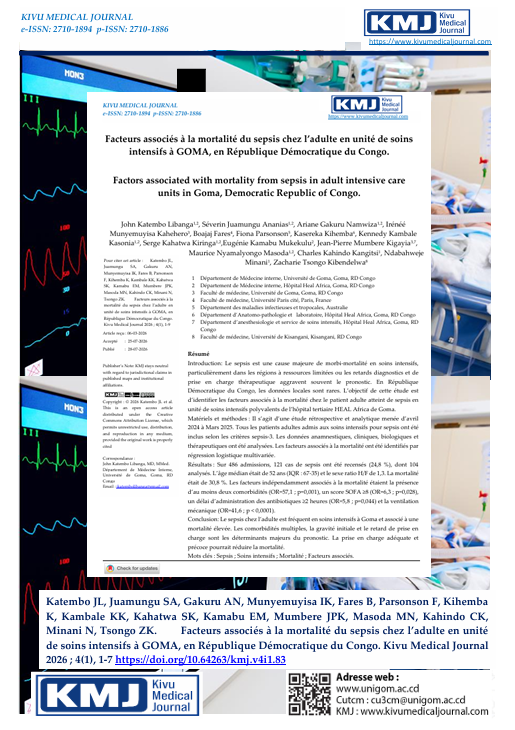
Factors associated with sepsis mortality among adults in intensive care units in Goma, Democratic Republic of Congo
Article Sidebar
Main Article Content
Abstract
Introduction: Sepsis is a major cause of morbidity and mortality in intensive care units, particularly in low-resource settings where diagnostic and therapeutic delays frequently worsen outcomes. In the Democratic Republic of the Congo, local data on sepsis remain limited. This study arms to identify factors associated with mortality among adult patients with sepsis admitted to the multidisciplinary intensive care unit of the tertiary HEAL Africa Hospital in Goma.
Material ans methods: This was a retrospective analytical study conducted from April 2024 to March 2025. All adult patients admitted to the intensive care unit with sepsis, defined according to the Sepsis-3 criteria, were included. Anamnestic, clinical, biological, and therapeutic data were collected and analyzed. Factors associated with mortality were identified using multivariate logistic regression analysis.
Results: Among 486 intensive care unit admissions, 121 cases of sepsis were identified (24.8%), of which 104 patients were included in the final analysis. The median age was 52 years (IQR: 35–67), and the male-to-female ratio was 1.3. The overall mortality rate was 30.8%. Independent factors associated with mortality were the presence of at least two comorbidities (OR = 57.1; p = 0.001), a SOFA score ≥ 8 at admission (OR = 6.3; p = 0.028), a delay in antibiotic administration of ≥ 2 hours (OR = 5.8; p = 0.044), and the use of mechanical ventilation (OR = 41.6; p < 0.0001).
Conclusion: Sepsis among adults is frequent in the intensive care unit in Goma and remains associated with high mortality. Multiple comorbidities, initial severity, and delays in management are the main determinants of poor outcomes. Early recognition and prompt, adequate management could help reduce sepsis-related mortality in this setting
Article Details

This work is licensed under a Creative Commons Attribution-ShareAlike 4.0 International License.
References
Singer M, Deutschman CS, Seymour C, Shankar-Hari M, Annane D, Bauer M, et al. The Third International Consensus Definitions for Sepsis and Septic Shock (Sepsis-3). JAMA 2016;315:801–10. https://doi.org/10.1001/JAMA.2016.0287.
Global report on the epidemiology and burden of sepsis : current evidence, identifying gaps and future directions. World Health Organization; 2020.
Kwizera A, Urayeneza O, Mujyarugamba P, Baelani I, Meier J, Mer M, et al. Epidemiology and Outcome of Sepsis in Adults and Children in a Rural, Sub-Sahara African Setting. Crit Care Explor 2021;3:E0592. https://doi.org/10.1097/CCE.
Mulatu HA, Bayisa T, Worku Y, Lazarus JJ, Woldeyes E, Bacha D, et al. Prevalence and outcome of sepsis and septic shock in intensive care units in Addis Ababa, Ethiopia: A prospective observational study. African Journal of Emergency Medicine 2021;11:188–95. https://doi.org/10.1016/j.afjem.2020.10.001.
Keeley AJ, Nsutebu E. Improving sepsis care in Africa: an opportunity for change? Pan Afr Med J 2021;40.
Diyoyo L, Mbombo W, Manzombi J, Bamenga T, Kilembe A. Prise en charge du choc septique en réanimation aux Cliniques Universitaires de Kinshasa - Annales africaines de médecine 2016:487–94. https://anafrimed.net/prise-charge-choc-septique-reanimation-aux-cliniques-universitaires-de-kinshasa/ (accessed January 17, 2026).
Niengo Outsouta G, Monkessa CMME, Elombila M, Gallou Leyono-Mawandza PD, Ontsira Ngoyi EN, Tsouassa Wa Ngono GB, et al. Sepsis et choc septique en réanimation à Brazzaville (Congo). Health Sci Dis 2023:101–8.
Hopkinson DA, Mvukiyehe JP, Jayaraman SP, Syed AA, Dworkin MS, Mucyo W, et al. Sepsis in two hospitals in Rwanda: A retrospective cohort study of presentation, management, outcomes, and predictors of mortality. PLoS One 2021;16:e0251321. https://doi.org/10.1371/JOURNAL.PONE.0251321.
John Bonnewell by P, Rubach MP, Egger JR, Crump JA, Thielman NM, Park LP. Sepsis in sub-Saharan Africa: a prospective observational study of clinical characteristics, management, and outcomes for adolescents and adults with sepsis in northern Tanzania 2020.
Lewis JM, Abouyannis M, Katha G, Nyirenda M, Chatsika G, Feasey NA, et al. Population Incidence and Mortality of Sepsis in an Urban African Setting, 2013-2016. Clin Infect Dis 2020;71:2547–52. https://doi.org/10.1093/CID/CIZ1119.
Bauer M, Gerlach H, Vogelmann T, Preissing F, Stiefel J, Adam D. Mortality in sepsis and septic shock in Europe, North America and Australia between 2009 and 2019- results from a systematic review and meta-analysis. Crit Care 2020;24. https://doi.org/10.1186/S13054-020-02950-2.
Thomas-Rüddel DO, Fröhlich H, Schwarzkopf D, Bloos F, Riessen R. Sepsis and underlying comorbidities in intensive care unit patients : Analysis of the cause of death by different clinicians-a pilot study. Med Klin Intensivmed Notfmed 2024;119:123–8. https://doi.org/10.1007/S00063-023-01037-4.
Zador Z, Landry A, Cusimano MD, Geifman N. Multimorbidity states associated with higher mortality rates in organ dysfunction and sepsis: a data-driven analysis in critical care. Crit Care 2019;23:247. https://doi.org/10.1186/S13054-019-2486-6.
Shariq T, Rahman AS, Jamal Q, Siddiqui M, Khan U, Taufiq F. The SOFA score as a mortality predictor in ICU patients: insights from a tertiary care hospital in Pakistan. BMC Res Notes 2025;19:12. https://doi.org/10.1186/S13104-025-07596-3.
Evans L, Rhodes A, Alhazzani W, Antonelli M, Coopersmith CM, French C, et al. Surviving sepsis campaign: international guidelines for management of sepsis and septic shock 2021. Intensive Care Med 2021;47:1181–247. https://doi.org/10.1007/S00134-021-06506-Y.
Prescott HC, Angus DC. Enhancing Recovery From Sepsis: A Review. JAMA 2018;319:62–75. https://doi.org/10.1001/JAMA.2017.17687.
Im Y, Kang D, Ko RE, Lee YJ, Lim SY, Park S, et al. Time-to-antibiotics and clinical outcomes in patients with sepsis and septic shock: a prospective nationwide multicenter cohort study. Crit Care 2022;26. https://doi.org/10.1186/S13054-021-03883-0.
Liu N, Ren J, Yu L, Xie J. Mechanical ventilation associated with worse survival in septic patients: a retrospective analysis of MIMIC-III. Journal of Emergency and Critical Care Medicine 2020;4. https://doi.org/10.21037/jeccm.2020.01.01.
Dhital R, Basnet S, Poudel DR. Predictors and outcome of invasive mechanical ventilation in hospitalized patients with sepsis: data from National Inpatient Sample. J Community Hosp Intern Med Perspect 2018;8:49–52. https://doi.org/10.1080/20009666.2018.1450592